Rules
Ecommerce store playbooks for digital products: what to build first
Sequence your first ecommerce store playbook: offer and pricing first, then checkout, tax and launch, with course marketing last. Links to three deeper guides.
What to take away
- Settle the offer and the price before you open a storefront.
- Build the smallest playbook that can take money and deliver the file.
- Handle registration, tax treatment, and fee tracking before launch day.
- Run course marketing last, after buyers finish what they paid for.
Start with the offer, not the store
A digital product store is a delivery mechanism, not a fix for a weak offer. Before you compare platforms, write one sentence naming the buyer, the problem, and the finished artifact they receive. If that sentence needs three clauses, you are holding two products.
Those choices decide everything downstream. Ticket size, refund posture, and whether the file is a template, a course, or a subscription all change checkout setup, tax handling, and support load. The digital product strategy choices connect a defined user problem to evidence, business value, and product decisions.
One quick test: can a stranger read the promise and predict what lands in their inbox? If not, keep editing.
Price the digital product before you build a checkout
Price drives your acquisition math. A low-ticket file survives paid traffic only when buyers return, upgrade, or refer. A higher-ticket course needs proof, samples, and a refund policy a reader can repeat back.
Write the refund line before the sales page. If you cannot defend it in one sentence, the promise is too vague.
Payment processing takes a percentage plus a fixed fee per transaction, so a small cart gives away more of each sale. The SBA guidance on managing business finances covers tracking those costs alongside your other operating expenses.
Register the business before the first sale
The IRS checklist for starting a business covers recordkeeping, tax registration, and employer identification steps. Handling this early keeps your payment processor account and your receipts consistent with the name buyers see.
Illinois sellers register with the Illinois Department of Revenue for a sales-tax permit before collecting tax on digital downloads. The five questions Chicago sellers ask answers each one plainly—registration, copyright filing, platform fees, and sales-tax nexus—before you spend on launch. If you sell outside Illinois, the same steps apply under your own state's revenue department.
A sequencing table for your first playbook
Run the stages in order. Skipping one usually shows up later as refunds or support email.
First playbook sequence
- Stage 1Offer buyer and artifact
- Stage 2Price ticket and refund line
- Stage 3Checkout platform, processor, tax
- Stage 4Launch one channel, first sale
- Stage 5Marketing proof, page, follow-up
Sequencing table for your first playbook
| Stage | Decision to make | Done when |
|---|---|---|
| 1. Offer | Who buys, and what they receive | One sentence, no qualifiers |
| 2. Price | Ticket size and refund line | You can defend the refund in one sentence |
| 3. Checkout | Platform, processor, tax handling | A test purchase clears and delivers |
| 4. Launch | One channel for the first visitors | That channel produces a sale |
| 5. Marketing | Proof, sales page, follow-up | Buyers finish the product and reply |
Each row is a decision, not a tool. At stage three, compare named checkout platforms—Gumroad, Lemon Squeezy, Shopify, or WooCommerce—on fee, delivery, and tax handling before you commit. You can swap providers without rewriting stages one and two.
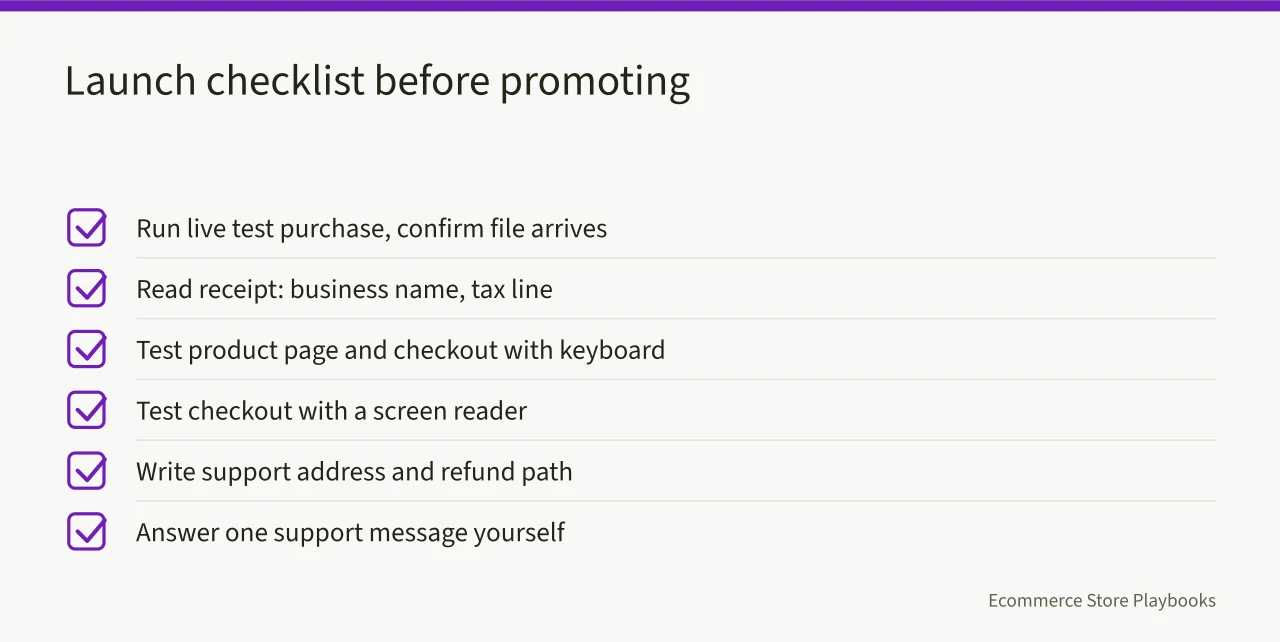
Launch checklist before you promote
- Run a live test purchase with your own card and confirm the file arrives.
- Read the receipt and check the business name and tax line.
- Test the product page and checkout with a keyboard and a screen reader.
- Write the support address and the refund path, then answer one message yourself.
Accessibility belongs inside the funnel, not in a later project. The WCAG standards describe the criteria a buyer using assistive technology needs your page to meet.
Example: first 30 days for a template pack
Days 1 to 7: write the offer sentence, the refund line, and three sample pages for a Notion template pack aimed at freelance graphic designers. Days 8 to 14: file Form SS-4, open a Stripe or PayPal account, and publish one product page on Gumroad or Lemon Squeezy.
First 30 days, template pack
- Days 1-7Offer sentence, refund line, samples
- Days 8-14Register, processor, product page
- Days 15-21Test purchase, delivery, no-mouse test
- Days 22-30Offer to one community, record questions
Days 15 to 21: run a test purchase, fix delivery, and test the checkout without a mouse. Days 22 to 30: offer the pack to one community you already belong to, then record every question buyers ask.
Those questions become your next product brief. A course only makes sense when the same problem keeps appearing.
Course marketing only after the promise holds
A course is not a bigger file. It is a promise with a timeline, and marketing it before completion rates are known produces refunds and silence.
The online course marketing brief starts with a credible learner promise, then proof, sales pages, measured acquisition, enrollment, and retention. Sequence it that way, or the ads will outrun the product.
Where the claims stop matching results
Launch stories usually omit the boring failure modes. Buyers who never open the file, refunds that arrive after payout, and ads that convert on a promise the product cannot keep all show up in the numbers first.
Track refund rate, completion, and support volume from the first week. If refunds climb while traffic is flat, the offer changed meaning, not the market.